|
%20by%20Thomas%20Quackenbush%20and%20Janet%20Goodrich..JPG)
|
NATURAL EYESIGHT IMPROVEMENT Bates Method
FREE 'Do It Yourself' Training for Perfect, Clearer Than 20/20 Eyesight. Correct Myopia, Presbyopia, Astigmatism and Other Eye-Vision Conditions Without Eyeglasses, SurgeryPERFECT SIGHT WITHOUT GLASSES Dr. Bates Original 1920 book in the Antique Print - FreeSEE BETTER NOW! Perfect Clearer Than 20/20 Vision at all Distances, Close and Far! Quick Easy TrainingCOPYRIGHT, DISCLAIMER, DIRECTIONS Ophthalmologist Bates Life History, Natural Eyesight Improvement Experience. AVOID the Harmful 'Plus Lens' Eyeglass Method! Dangers of Laser Cornea Surgery, Most Cataract Surgeries, Contact Lenses. Avoid un-natural teachers illegally using our books, website title, videos CONTACT, Phone, Address - Question Answer Page. Video; Dangers, Blindness, Vision Problems Caused by Cornea Laser Surgery, Contact Lenses. AMAZON.COM, Barnes & Noble... CUSTOMERS20 FREE Bates Method, Natural Eyesight PDF E-Books; Direct Link to the Download Page. Thank-You For 12 Years Support!BOOKSTORE Paperback Books by Dr. Ophthalmologist William H. Bates, Emily Lierman, Other Doctors and Teachers. Eyecharts, Videos-Free Training. EFT - Emotional Freedom Technique, Acupressure and Color Breathing... View, Description, Directions for, link to 20 FREE Color Natural Eyesight Improvement PDF E-Books GOOGLEBOOKS; Natural Eyesight Improvement PAPERBACK and E-BOOKS. Read 100% Internal Pages BOOKS - Paperback, Kindle. Variety of Natural Eyesight Improvement Books, Training by Different Teachers. Iridology, Breathing, Nutrition, Body Movement and Relaxation Tools, Strengthen the Mind, Spirit... Self-Help. Better Eyesight Magazine, Books by Ophthalmologist William H. Bates. Shop at Amazon and Other New and Used Paperback Bookstores PINHOLE EYEGLASSES - Pros and Cons, Mostly Cons. AVOID!Vitamins, Minerals.., Eye Health Vitamins; Bilberry, Lutein... Ming Mu Di Huang Wan Ancient Chinese Eye Formula for Healthy Eyes, Body, Liver, Clear Eyesight. Neck Muscle Relaxation. Health BooksTRANSLATOR Convert Website Pages, E-Books to Other Languages. Audio; Hear in English, Spanish... Blind; Listen, Learn Without Reading HISTORY The Bates Method, Natural Eyesight Improvement - Best Teachers, Books, Websites, Blogs, Training, variety of Information. 1800's, 1901 to Present Date BETTER EYESIGHT MAGAZINE By Ophthalmologist William H. Bates', Introduction. 132 Issues, July 1919 to June 1930. Original Training, Cures from the Eye Doctor that Discovered Natural Vision Improvement BETTER EYESIGHT MAGAZINE - Entire 132 Issues on One Page or Link to the Main Magazine Website, Individual Monthly Issues. Read, Listen Free on the Internet in any LanguageAUDIOS For the Blind, Low Vision - Better Eyesight Magazine Treatments; Myopia, Presbyopia, Cataract Glaucoma, Retina Health, Strabismus, Astigmatism...Dedication to My Mom Nancy Native American Videos - Natural Life=Clear Sight SKYPE, GOOGLE Live Video on the Internet - Telephone Natural Eyesight Improvement Training. Student and Group Training 1 - Natural Eyesight Training Starts Here, Page #1 to #40. MENTAL STRAIN, EYE MUSCLE TENSION CAUSES UNCLEAR EYESIGHT. Dangers of Laser Eye Cornea Surgery, Eyeglasses and Contact Lenses2 - STRONG EYEGLASSES = Addiction, Progressive Vision, Eye Impairment Verses REDUCED, WEAKER, TEMPORARY EYEGLASS LENSES = Vision, Eye Health Improvement. EYEGLASSES Low Cost Reduced 20/40, 20/50 Weaker Prescription Lenses by Mail & Behavioral Optometrists. Pass the Drivers License Eyesight Exam - Practice on the Govt. RMV, DMV... Eyecharts 3 - HUMAN EYE Function, Anatomy, Light Rays, Cornea, Iris-Pupil, Lens, Retina, Macula, Fovea, Optic Nerve, Eye Muscles...4 - Front View of Eye. Pupil, Iris, Ciliary, Lens, Sclera.., Outer Eye Muscles; Oblique, Recti. THE EYE CHANGES LENGTH LIKE A CAMERA (with the lens) TO FOCUS CLOSE- FAR 5 - DO IT YOURSELF NATURAL EYESIGHT IMPROVEMENT; Practice Shifting and Other Relaxed, Natural, Correct Eye-Vision Functions. The IMAGINARY NOSEFEATHER Play with the Moving Pointer to get the Eyes Shifting, Relaxed. Move with the Figure Eight. 6 - CENTRAL-FIXATION - Central Vision 'Centralizing'. See Clearest with the Center of the Visual Field. Combine With Shifting. The Central Field MOVES as the Eyes, Mind-Attention Move 'Shift'7 - CENTRAL-FIXATION STICK Use the Gate to Find the Exact Central Field and Move it. Test for Balanced Eyes, Vision8 - MEMORY AND IMAGINATION Improve the Mind, Eyesight, Body, Sprit. PALMING, EFT9 - TEN CORRECT, RELAXED, NATURAL VISION HABITS Practice Normal, Eye-Vision 'Visual System' Functions10 - SWITCHING, SHIFTING CLOSE, MIDDLE AND FAR For Clear Eyesight at All Distances. Bates Method Combined with Behavioral Optometry, Relaxed Eye Exercises11 - SWITCH CLOSE, MIDDLE, FAR ON THE THREE PENS IN A ROW. THE BEAD (BROCK) STRING12 - WARNING - Avoid Artificial 3-D Fusion Pictures, Repetitive Eye Exercises; 'Autostereograms, 'Magic Eyes' 13 - EYECHARTS TEST AND IMPROVE CLOSE AND DISTANT EYESIGHT Eyechart Pictures From Dr. Bates Medical Articles14 - THE FIGURE EIGHT (Infinity Swing)Left and Right Brain Hemisphere Activation, Integration, Neck, Body Movement, Relaxation15 - THE SWAY, 'Rock', LONG SWING, CROSS CRAWL and Other Movement, Relaxation, Body-Brain Activities For Clear Eyesight16 - THE ILLUSION OF OPPOSITIONAL MOVEMENT-'The Swing'17 - SUNLIGHT, SUNNING. SACCADIC SUNNING With Hands 18 - SACCADIC SUNNING With Tree, Fence, Nosefeather, Swing, Rocking Chair, Oppositional Movement19 - DR. BATES SUNLIGHT TREATMENTS, PICTURES - As Described in Better Eyesight Magazine and Perfect Sight Without Glasses 20 - SUNLIGHT, LIGHT ENERGY TRAVELS INTO THE EYES, OPTIC NERVES, BRAIN, SPINE, BODY, CHAKRAS 'Energy Centers, Pathways' 21 - RELAXATION METHODS; PALMING, Color Visualization, Breathing, Energy Circulation, Alpha, Theta, Delta Deep Relaxation Chart 22 - COLOR, COLORED LIGHT TREATMENT; Antique Colored Glass Bottle, Sunlight, Color Changing Angel Lamp for Night-time 23 - NEAR VISION; Clear Eyesight at Close Distances. READ IN FULL SPECTRUM SUNLIGHT, FINE PRINT HEALTHY FOR THE EYES - Reading, Seeing Fine and Microscopic Print Clear. Natural Presbyopia Cure, Prevention. Book 24 - CORRECT, RELAXED NATURAL VISION HABITS CARD For Clear Close and Far Vision. THUMB- FINGER MOVEMENT, 'OPPOSITE SWING'25 - NIGHT VISION See Clear in Lower light, Moonlight. Cones, Rods in the Retina, Visual Purple 26 - ASTIGMATISM TEST & REMOVAL, CHARTS, SWINGS27 - STRABISMUS Crossed/Wandering Eyes Correction 28 - GOOD POSTURE For Relaxed Body, Shoulders, Neck, Eye Muscles, Balanced Movement and Clear Eyesight29 - PATH OF LIGHT RAYS AND EYE MUSCLES, NERVES IN THE EYES, BRAIN, BODY. Chiropractic Treatment Vs. Physical Therapy, Massage. CHIROPRACTIC Causes Stroke, Blindness, Death, Paralysis... Videos 30 - PHYSICAL THERAPY - For Relaxed Body, Shoulders, Neck, Head and Clear Eyesight. Vertebrae C-1 Top of Neck to C-5 Upper Spine 31 - ACUPRESSURE POINTS, MASSAGE Face-Eyes, Head, Neck, Shoulders, Back, Body, Hands, Feet... for Muscle Relaxation, Balanced, Moving Chi... Energy and Clear Eyesight. EFT 32 - NUTRITION For Healthy Eyes, Clear Eyesight. Grow Your Own Bilberries, Blackberries, Spinach, Kale, Corn, Dandelions, Flowers, Carrots... For Healthy Retina, Lens...33 - For Pilots - Aviators - Better Eyesight Magazine. Warning; Avoid The Plus Lens-Anti-Corrective Method. 34 - STORIES FROM THE CLINIC by Emily C. A. Lierman, Bates. Dr. Bates Assistant, Wife for Many Years in His New York City Clinic, Offices...35 - THE CURE OF IMPERFECT SIGHT BY TREATMENT WITHOUT GLASSES Dr. Bates Original 1919 Book. And; 'Use Your Own Eyes', 'Normal Sight Without Glasses' by Dr. William B. MacCracken M. D., 'Strengthening The Eyes' by Bernarr MacFadden, W. H. Bates. Optometrist Harold M. Peppard, Monroe Hirsch, O.D. Ph. D. E-Books, Videos36 - Clark Night - (Mary Iva Oliver) Natural Eyesight Improvement School, Courses Certificates, Receipts. 1st Book Copyright 1996+ 37 - Clark Night -(Mary Iva Oliver) Drivers Licenses, Family Photos - No Glasses, Proof of Clear Vision. Govt. Directions for Eyesight Test 38 - Blind, Visually Disabled Achieve Independence - Guide Dog Schools, DAV, Perkins School For The Blind 39 - NEW STUFF! What's Up in the Natural Eyesight Improvement World? Lasik, Contact Lens Warning Videos. Corrupt Teachers, Author's Teaching Incorrect, Harmful Methods, Steal Manuscripts, Hack Honest Teachers Computers, Try to Hide the True Bates Method and Charge High Prices40 - VIDEOS - Natural Vision Improvement and Other Topics GUEST PAGE Post a Comment, Ask Questions, State Your Opinion, Share Dr. Bates Method, Natural Eyesight Improvement Experiences. BEST FORUMS, GROUPSOther Things, Discussions... BOOK REVIEWS, Comments on Amazon.com, The Best Books, Teachers. + How to Avoid Harmful Methods. +Write a Review of Your Favorite Books on Amazon, Barnes and Noble, Indie, GoodReads...Password page #1 For E-books in Event the Download Page Traffic is Too High Causing Slow Connection. Password Page #2 Extra books For Blind Persons That Prefer a Private Page, Special Requests Chiropractors in Worcester, MA Purposely Misaligning Neck Bones, Spine... in Order to Sell Hundreds of Follow-up Treatment. Causing Paralysis, Stroke, Vision, Hearing Impairment, Stroke, Death |
THE CENTRAL FIXATION STICK IMPROVES CENTRAL FIXATION - SEEING CLEAREST WITH THE CENTER OF THE VISUAL FIELD   WHEN VISION IS VERY UNCLEAR, OBJECTS, PARTS OF OBJECTS IN THE VISUAL FIELD BLUR TOGETHER. THE CENTRAL AND PERIPHERAL FIELDS BLUR TOGETHER. THIS INTERFERES WITH CENTRAL FIXATION. CENTRAL FIXATION = TO PLACE ONE OBJECT, ONE SMALL PART OF THE OBJECT AT A TIME IN THE CENTER OF THE VISUAL FIELD, SEEING ONE SMALL PART OF THE OBJECT CLEAREST AT A TIME IN THE CENTER OF THE VISUAL FIELD.
REMEMBER; THE EYES CONTINUALLY MOVE 'SHIFT'; THE CENTRAL FIELD
MOVES FROM OBJECT TO OBJECT, PART TO PART... AS DESCRIBED IN THE
SHIFTING AND CENTRAL-FIXATION CHAPTERS. I PREFER THE WORD
'CENTRALIZING' INSTEAD OF CENTRAL-FIXATION BECAUSE CENTRALIZING
PREVENTS THE THOUGHT OF FIXING THE EYES, VISION IMMOBILE UPON A
POINT. IMMOBILITY, STARING, SQUINTING CAUSES UNCLEAR VISION.
MOVEMENT,
RELAXATION BRINGS CLEAR VISION.
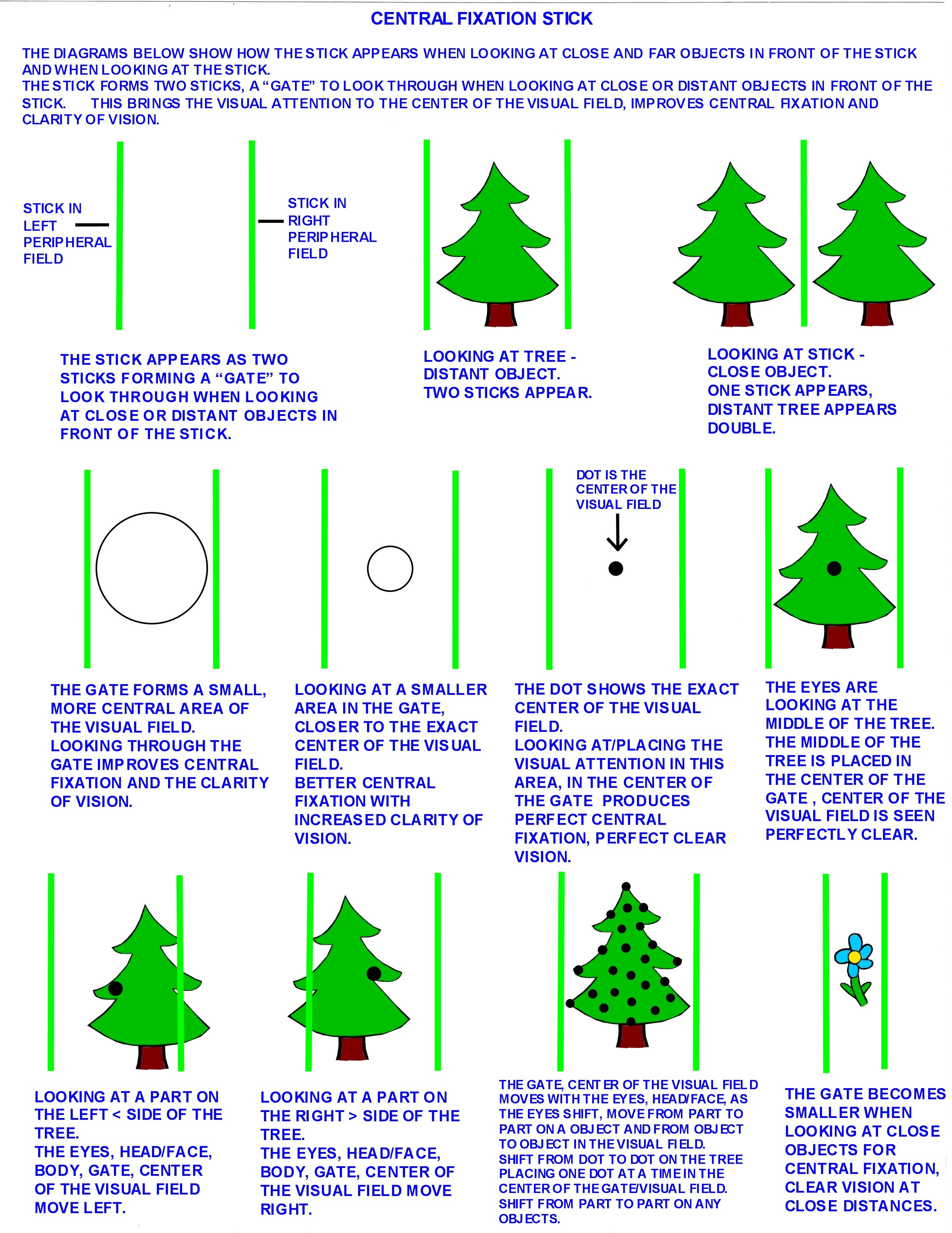
THE CENTRAL FIXATION STICK IS PLACED IN FRONT OF THE FACE TO FORM A GATE TO LOOK THROUGH. THE CENTRAL FIXATION STICK IMPROVES CENTRAL-FIXATION BY BRINGING THE VISUAL ATTENTION TO THE CENTER OF THE VISUAL FIELD EVEN WHEN THE VISION IS VERY UNCLEAR. THE CENTRAL FIXATION STICK GATE, IT'S CENTRAL FIELD MOVES WITH THE EYES, THE EYES CENTRAL FIELD. THIS IMPROVES SHIFTING, EYE, HEAD, BODY MOVEMENT AND OTHER CORRECT EYE/VISION FUNCTIONS. ALL THESE FUNCTIONS IMPROVE THE CLARITY OF VISION. SEE PICTURES, DIRECTIONS;
THE
PERIPHERAL FIELD ALSO MOVES WITH THE EYES, AROUND OUTWARD FROM
THE CENTRAL FIELD, BUT; THE BRAIN, PERIPHERAL TAKES CARE OF
ITSELF.
THE EYES, BRAIN'S ATTENTION IS ON THE OBJECT IT WANTS TO SEE, PLACES IT IN THE CENTRAL FIELD. THE BRAIN, EYES ALSO SENSE OBJECTS IN THE PERIPHERAL BUT THE ATTENTION IS NOT ON THEM UNLESS THE MIND DECIDES TO LOOK AT THEM; THEN THE EYES, HEAD TURN AND PLACE THAT OBJECT INTO THE CENTRAL FIELD. SO; JUST PLACE THE OBJECT YOU WANT TO SEE IN THE CENTRAL FIELD. MIND, EYES ON THE OBJECT OF VISUAL ATTENTION. THIS IS REST, RELAXATION, BRINGS CLEAR VISION. TRYING TO SEE-THINK ABOUT MORE THAN ONE THING AT THE EXACT SAME TIME CAUSES STRAIN, DIFFUSION, ECCENTRIC-FIXATION (THE OPPOSITE OF CENTRAL-FIXATION) AND UNCLEAR VISION. TRY IT; TRY TO SEE, THINK ABOUT TWO DIFFERENT OBJECTS OR TOW OR MORE PARTS OF A OBJECT AT THE SAME TIME; ONE OBJECT IN THE CENTRAL FIELD, THE OTHER IN THE PERIPHERAL; NOTICE STRAIN, TENSION OCCURS. NOW; BRING THE MENTAL-VISUAL ATTENTION TO ONE OBJECT AT A TIME; LOOK AT, THINK ABOUT ONE OBJECT OR ABOUT ONE PART OF A OBJECT (EYES STILL MOVING UPON THE PART. BLINK, RELAX); NOTICE RELAXATION, CLEAR VISION OCCUR. REMEMBER; THE EYES, MIND CAN MOVE TO A NEW OBJECT, PART, POINT OF ATTENTION IN A FRACTION OF A SECOND, BUT; DURING THE TIME THE MIND, EYES ARE LOOKING AT A OBJECT, PART... EVEN IF ONLY FOR A SECOND; IT IS IN THE CENTRAL FIELD AND SEEN BEST, MOST CLEAR. EACH NEW OBJECT, PART THE ATTENTION, EYES MOVE TO WILL MOVE INTO THE CENTRAL FIELD AND THEN BE SEEN CLEAREST. THE DIAGRAMS BELOW SHOW CORRECT IMAGES SEEN WHEN WEARING THE CENTRAL FIXATION STICK. WHEN LOOKING AT THE STICK (CLOSE OBJECT) IT SHOULD APPEAR CLEAR, SOLID, ONE STICK IN THE CENTER OF THE VISUAL FIELD. THE TREE IN THE DISTANCE SHOULD APPEAR DOUBLE; TWO TREES. THE TREES ARE SPACED EQUALLY, EVENLY IN THE PERIPHERAL FIELD ON THE LEFT AND RIGHT SIDES OF THE STICK. THE TWO IMAGES OF THE TREE ARE EQUALLY SOLID (NO LIGHT, DULL, GHOSTLY IMAGES). THE TWO TREES ARE AT A EVEN HEIGHT. WHEN LOOKING AT THE TREE (DISTANT OBJECT) IT SHOULD APPEAR CLEAR, SOLID, ONE TREE IN THE CENTER OF THE VISUAL FIELD, IN THE CENTER OF THE GATE FORMED BY THE STICK WHICH NOW APPEARS DOUBLE. THE STICK APPEARS AS TWO STICKS SPACED EQUALLY, EVENLY, IN THE PERIPHERAL FIELD ON THE LEFT AND RIGHT SIDES OF THE DISTANT TREE. THE TWO IMAGES OF THE STICK ARE EQUALLY SOLID (NO LIGHT, DULL, GHOSTLY IMAGES). THE TWO STICKS ARE AT A EVEN HEIGHT. THE STICKS ARE STRAIGHT, VERTICAL;
THE DIAGRAMS BELOW SHOW DIFFERENT IMAGES THAT MIGHT BE SEEN WHEN USING THE CENTRAL FIXATION STICK. INCORRECT IMAGES INDICATE THAT VISION NEEDS IMPROVEMENT IN THE LEFT AND/OR RIGHT EYE/EYES AT CLOSE AND/OR FAR DISTANCES. ALL NATURAL EYESIGHT IMPROVEMENT CORRECT VISION HABITS, SHIFTING, CENTRAL FIXATION, RELAXATION, LONG SWING, OTHER ACTIVITIES ON THIS WEB SITE INCLUDING; SWITCHING ON OBJECTS AT CLOSE AND FAR DISTANCES, PRACTICING WITH THE BEAD STRING, PENS IN A ROW, CORRECT VISION HABITS CARD WITH BOTH EYES TOGETHER, THEN ONE EYE AT A TIME, THEN BOTH EYES TOGETHER AGAIN... RETURNS NORMAL EYE FUNCTION AND CLEAR VISION. 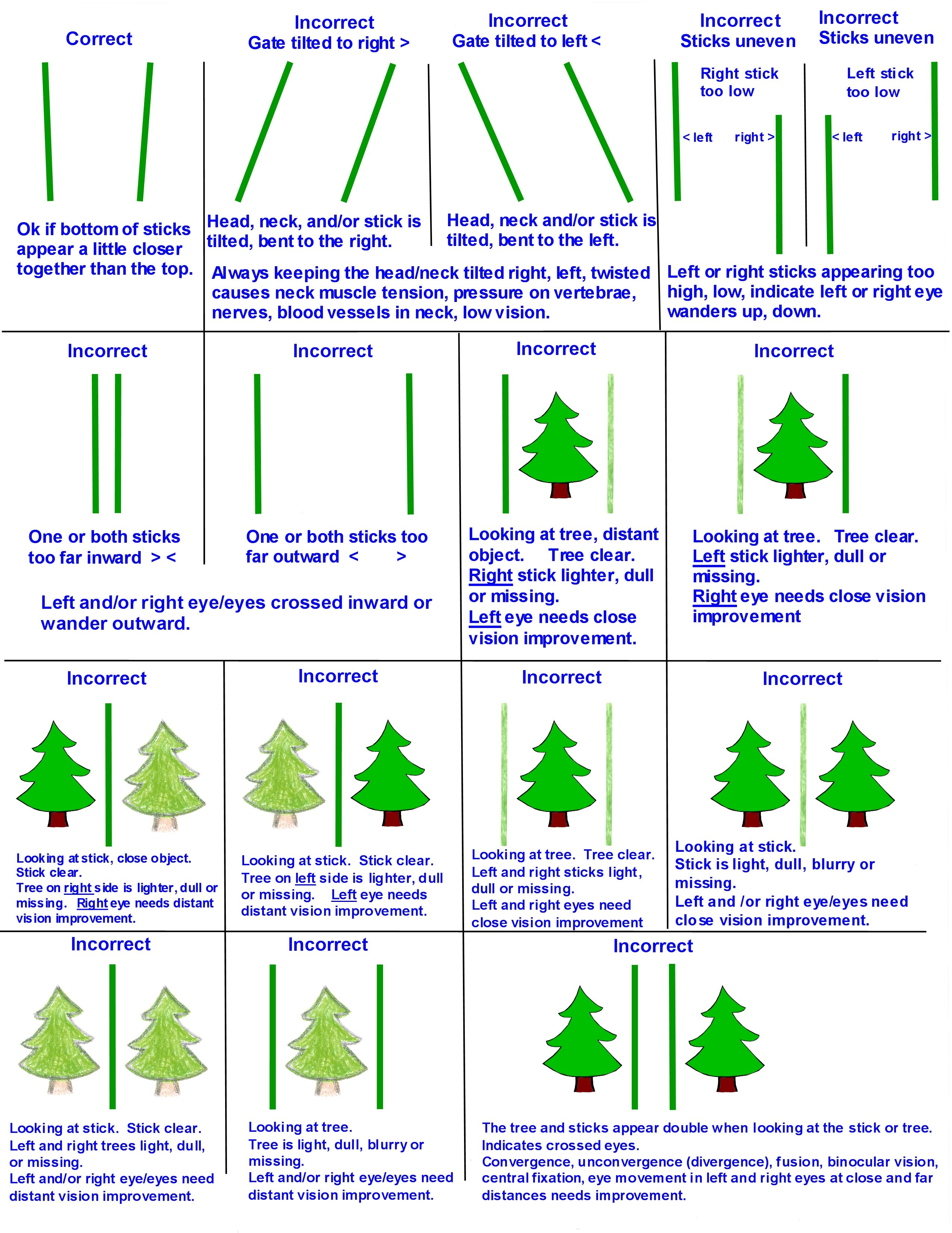 IN THE DIAGRAM ABOVE, LAST TWO BOXES ON TOP RIGHT SIDE; TO DETERMINE IF ONE STICK IS HIGHER OR LOWER THAN THE OTHER STICK; TAPE A SMALL PIECE OF WHITE PAPER TO THE STICK AT EYE LEVEL. THEN LOOK TO THE DISTANCE, AND SEE THE STICK APPEAR AS TWO STICKS. THE WHITE PAPER WILL ALSO APPEAR DOUBLE. IF ONE PAPER IS HIGHER OR LOWER THAN THE OTHER PAPER AND THE HEAD, NECK, STICK ARE STRAIGHT, NOT TILTED, THEN THIS IMAGE MAY INDICATE ONE EYE WANDERS UP, DOWN, INCORRECT CONVERGENCE, DIVERGENCE. A GOOD METHOD TO CORRECT THIS CONDITION IS TO IMAGINE THE STICKS/PAPERS ARE AT A EVEN HEIGHT. PRACTICE THIS WITH THE EYES OPEN, CLOSED, OPEN. THEN RELAX, LOOK AT THE STICK, SHIFT ON THE PAPER A SECOND, THEN SHIFT ON A DISTANT OBJECT, THEN THE PAPER... THEN REMEMBER, IMAGINE THE PAPERS AT A EVEN HEIGHT AGAIN. THIS GETS THE BRAIN, EYES WORKING TOGETHER, CORRECT. USE THE STICK TO TEST THE VISION, TEST FOR CORRECT AND INCORRECT IMAGES FOR A SHORT TIME. THE MAIN FUNCTION OF THE STICK IS TO IMPROVE CENTRAL FIXATION AND OTHER CORRECT VISION HABITS BY LOOKING THROUGH THE CENTER OF THE GATE, SHIFTING ON OBJECTS IN THE VISUAL FIELD THROUGH THE GATE, MOVING THE GATE TO IMPROVE SHIFTING, MOVEMENT OF THE HEAD/FACE, BODY WITH THE EYES. CHECK TO SEE IF THE CENTRAL AND PERIPHERAL IMAGES APPEAR CORRECT AND IF NOT; CHECK WHICH EYE (ONE OR BOTH) IS CAUSING A INCORRECT IMAGE. COVER ONE EYE AT A TIME. WHEN THE INCORRECT IMAGE DISAPPEARS, THE COVERED EYE IS THE EYE THAT IS CAUSING THE INCORRECT IMAGE AND NEEDS VISION IMPROVEMENT. ONCE THIS IS DETERMINED YOU CAN PRACTICE CORRECT VISION HABITS AND OTHER ACTIVITIES ON THIS WEB SITE TO IMPROVE THE VISION. RETURN TO THE TEST OCCASIONALLY TO CHECK FOR VISION IMPROVEMENT. WHEN USING THE GATE TO TEST THE VISION, CHECKING FOR INCORRECT AND CORRECT IMAGES; AVOID TRYING TO MAKE THE DOUBLE IMAGES OF OBJECTS IN THE PERIPHERAL FIELD AS CLEAR AS THE SINGLE OBJECT THE EYES ARE LOOKING AT IN THE CENTER OF THE VISUAL FIELD. The central fixation stick is
made of flexible metal wire; coat hanger, copper wire, wood... The width of the stick is 1/8 inch, about
the width of a old metal coat hanger. The wire (including ends of the wire) is coated with soft plastic. Plain plastic
contains a variety of toxic chemicals that can enter the body through the skin when worn against the skin. The stick
is coated with organic, chemical free plastic or other non-toxic substances. New material
that is similar to plastic is chemical free, non toxic, made from corn, vegetables and other edible ingredients. Metal disrupts, blocks the flow of the bodies chi and other energies. Wearing metal on the head and around/near
the eyes impairs energy flow in the eyes, brain and body. It is best to make the central fixation
stick without metal. A wooden stick, sanded smooth, no splinters, can be covered with colored
cloth. Use organic, chemical free dye in the cloth. Metal frame
glasses also impair energy flow in the eyes, brain, body. Plastic, rubber and other substances
in the frames and lenses exposes the skin to toxic chemicals. The chemicals soak directly into the
circulation near and into the eyes, brain and then entire body. Ask a karate, tai chi, acupuncture, yoga
instructor for information on the bodies energies.
Assembly Form a circle out of one end of the wire and hook the remaining part of the wire onto the front of the circle. See diagrams. The circle fits onto the top of the head. The wire that extends
out from the front center of the circle/center of the forehead is bent upward and angled forward. Then; move about 4
inches upward on the wire and bend that area of the wire down so the wire is in front of the face. This is the central fixation stick. The stick is straight, vertical. ι The
stick is placed between the left and right eyes in the center of the visual field. If the nose is straight,
then the stick can be placed in front of the end of the nose to align it perfectly between the left and right eyes. The stick is placed about
3 inches from the end of the nose, (4 inches from the eyes). The stick is colored; green, blue, orange, any
color that is easy to see. The stick is long, the end extending below the bottom of the neck so it does not press into the neck
if the person looks down. The round part of the stick
is placed on the head with the stick upright/vertical in front of the face/nose, between the eyes, in the center
of the visual field. The stick and head are straight, not tilted left
or right. The stick produces the same effect as is seen when placing a pencil upright in front of the eyes/nose and then, switching the visual attention close and far on the pencil and a distant object, except that the stick is closer to the eyes and does not have to be held up with the hand. keeping
the hands free prevents muscle tension, fatigue in the hand, arm, shoulders, neck, head, eyes and allows for complete freedom
of movement. Do not run around, play, work when wearing the stick. Children must be supervised by
parents when wearing the stick. Keep the ends of the stick away from the face, eyes, neck. Practice Central-Fixation (Centralizing) with the stick Wear the stick. Look
at a object in the distance in front of and in line with the stick. Place the object in the center of the visual
field. Example; see the distant tree inside the gate in the diagram. When looking at the distant
tree, notice that the stick appears double, two sticks appear; ι ι one stick in the left peripheral field, one stick in the right peripheral field. The
sticks are equally/evenly spaced on the left and right sides of the distant tree. The tree is inside the gate. The
two sticks form a space, a 'gate.' The eyes look through this gate. Looking through the gate
activates, improves central fixation and the clarity of vision. See the circle in the gate on the diagram
above. The center of the visual field is in the center of the circle, inside the gate, in the center of
the gate and is the clearest area of the visual field. The center of the gate is the exact center, most
clearest area of the visual field, clearer than 20/20; 20/10, 5 and clearer. In the diagram,
the dot is in the center of the gate, center of the visual field. The dot is between the left and right eyes, at
eye level. The true exact center of the visual field is smaller than the dot (about the size of the pointed end
of a pin) and produces very clear, fine tuned vision, ability to see very small parts, fine details of objects clear. This
very clear point is produced by the center of the fovea centralis in the center of the macula, center of the eyes retina. The
exact center of the visual field is clearer than 20/20; 20/10, 5 and clearer with bright color. Central fixation
= seeing clearest with the center of the visual field improves the clarity of the entire visual field, central and peripheral
field. Placing the part of the object the eyes are looking at in the center of the gate, exact center of the visual
field is perfect central fixation. +The center of the gate/center of the visual field is clearest. +The
other areas inside the gate; around, near and away from the center (dot) are the inner peripheral field and are clear but
not as perfectly clear as the center of the gate , center of the visual field. +Areas of the visual field outside
the gate, near and away from the gate are in the outer peripheral field and are less clear than areas inside the gate. The
area farthest away from the gate is the far outer peripheral field and is most unclear. This is normal vision. The
center of the visual field is clearest. The peripheral field is less clear. The center of the gate is clearest. See
objects, parts of objects clear with the center of the gate, center of the visual field. The fovea centralis, macula and many cones in the center of the eyes retina produce perfect clear vision and brightest color in the center of the visual field. The rods and low amount of cones in the peripheral area of the eyes retina (away from the fovea,
macula, center the retina) produce the less clear peripheral field of vision. The rods also detect movement
in the visual field and continue to function in very dim light, almost complete darkness. See one small part of a object clearest at a time in the center of the visual field. Example; Look through the gate at a tree in the distance. Look at a part on the middle of the tree. Place the center of the gate (dot), center
of the visual field on the part, middle of the tree. The part, middle of the tree is in the center of the visual
field and is seen clearest. The two sticks are evenly spaced on the left and right sides of the tree in the peripheral
field. Areas of the tree inside the gate, away from the dot are in the inner peripheral field and are clear but
not as perfectly clear as the central area (center of the visual field) the eyes are looking at represented by the dot. Areas
of the visual field outside the gate away from the tree are most unclear. The gate/center of the visual field moves with the eyes (head/face and body moving with the eyes) as the eyes shift from object to object and part to part on objects. The moving gate keeps each object, each part of a object the eyes look at in the center of the visual field
and perfectly clear. Example; Look at a part on the left side of the tree. The eyes shift
to and look at the part on the left side. The eyes, head/face, gate, center of the visual field and body shift/move
left. (See dot on the left side of the tree in the diagram.) The center of the gate/center of the visual
field (dot) is placed on the part on the left side of the tree. This part is now in the center of the visual field
and is seen clearest. Next; look at a part on the right side of the tree. The eyes
shift to and look at the part on the right side. The eyes, head/face, gate, center of the visual field and body
shift/move right. (See dot on the right side of the tree in the diagram.) The center of the gate/center
of the visual field (dot) is placed on the part on the right side of the tree. This part is now in the center of
the visual field and is seen clearest. Next; Look at the diagram of the tree that has many dots
on it. Shift from dot to dot, (part to part) on the tree. Now do this on a real tree in the distance. Shift
the eyes (visual attention) continually, easy, relaxed, from part to part on the tree; left and right, top and
bottom, corner to corner, middle and in any direction. Move the head/face, center of the gate, center of the visual
field and the body with the eyes as the eyes shift from part to part, placing one small part at a time in the center of the
gate/visual field, seeing one small part clearest at a time in the center of the visual field. Next; Look
at objects in your environment; in the room, out the window, go outside and walk around wearing the stick. Shift
the eyes, visual attention from object to object at any distance, close, middle, far, left, right, up, down.., and move
the head/face, gate, center of the visual field, body with the eyes seeing each object/part of a object the eyes look at perfectly
clear in the center of the gate/visual field. Blink, breathe abdominally, relax. Move the head/face and body with the eyes at the same time, in the same direction. Moving the head/face, body with the eyes keeps the
gate moving with the eyes, keeping objects, parts of objects in the center of the gate/visual field. Use the Imaginary Nosefeather With the Gate. (See chapter 8, the Nosefeather.) The
nosefeather activates central fixation, shifting, synchronized movement of the head/face, body with the eyes and eye head/face,
neck, body relaxation. The end of the feather touches the center of the gate, touches the part of the object
the eyes are looking at between the eyes, at eye level, in the center of the visual field. Move, "shift"
the eyes, end of the feather, center of the gate/visual field from object to object and part to part on objects. Trace
objects, parts of objects with the eyes and end of the nosefeather. Test and improve the clarity of vision in the left and right eyes at close and far distances with the central fixation stick. (See diagrams above for correct and incorrect images.) 1 - Look at the tree, distant object. Shift on the
tree. One tree is seen. The stick, close object appears double, two sticks. One stick on the
left side of the tree in the left peripheral field. One stick on the right side of the tree in the right peripheral
field. The two sticks are evenly spaced on the left and right sides of the tree. The two sticks are
at the same height. The tree is in the middle of the two sticks. This is a correct image. (When looking at a object beyond the stick at any distance; use correct vision habits; shift on the object, small part to small part, apply central fixation, relax.) 2 - Look at the stick, close object. Shift on
the stick. One stick is seen. The tree in the distance appears double, two trees. One tree on
the left side of the stick in the left peripheral field. One tree on the right side of the stick in the right peripheral
field. The two trees are evenly spaced on the left and right sides of the stick. The two trees are at
the same height. The stick is in the middle of the two trees. This is a correct image. 3 - Look at the tree. The two sticks in the left and right peripheral field should appear equally visible. The
two sticks are the images produced by the left and right eyes. If one stick is lighter, dull, ghostly; this is a
incorrect image and indicates that the eye producing that incorrect image needs vision improvement. Cover one eye
at a time to determine which eye is producing the incorrect image. When the incorrect image of the stick (lighter...
stick) disappears, the eye that is covered is the eye that is producing the incorrect image and needs vision improvement. Example;
if the stick in the right peripheral field is light, ghostly and then, the left eye is covered and that image
of the stick on the right disappears, this indicates that the left eye is causing the lighter image on the right
side. The left eye needs close vision improvement. If both left and right images of the stick are light,
ghostly; both eyes need close vision improvement. See diagrams. Notice that when looking at the tree, far distance; the left eye sees the right image of the stick, and the right
eye sees the left image of the stick. Repeat the previous test on the images of the tree; Look
at the stick. Notice the distant tree appears as two trees in the peripheral field on the left and right sides of
the stick. If one tree is lighter, dull, ghostly; cover one eye at a time to determine which eye is causing
the incorrect image. When the lighter, incorrect image of the tree disappears, the covered eye is the eye causing
the incorrect image and that eye needs distant vision improvement. If both left and right images of the tree are
light, ghostly; both eyes need distant vision improvement. Notice that when looking at the stick, close distance; the
left eye sees the left image of the tree, and the right eye sees the right image of
the tree. +When looking at the distant tree, if the bottom of the sticks appear a little closer together than the top, this is a normal visual effect. +If one or both sticks appear extremely angled, tilted to the left or right; this indicates that the head/face, neck is tilted, bent to the left or right side - incorrect posture. The
head, neck, body should be straight, aligned. If the stick or gate (two sticks) appear tilted it may mean that the
stick itself is tilted left or right. Place the stick straight, upright. If the stick, head, neck are
straight but one or both sticks are tilted, curved, distorted, this can indicate astigmatism, crossed, wandering eye/eyes. Convergence,
divergence, accommodation, un-accommodation, eye movement, central fixation, in one or both eyes needs improvement. Function
of the brain, left and right brain hemispheres with the eyes may also need improvement. +If the two images of the stick are too close together, too far apart, or are uneven; one stick higher, lower than the other, this can indicate crossed, wandering eye/eyes, imperfect convergence, un-convergence (divergence), accommodation, un-accommodation. Tape
a small piece of white paper on the stick at eye level, then look to the distance to see if one stick/paper is higher,
lower. Remembering, imagining the sticks (white paper) at a even height and all images correct with the eyes open, closed, then open again helps to correct these images and bring clear vision. See diagrams on this page for
more incorrect images, their causes and cures. More directions on how to correct the incorrect images, activate
normal eye function and clear vision are listed at the end of this chapter. +Amblyopia - low, dull, ghostly or no vision in one or both eyes occurs when the vision is very unclear often when the eye wanders extremely in, out, up, down... to the point that it interferes with overall vision. The brain will temporarily shut off the visual
image received by the eye that is functioning incorrect in an attempt to remove the incorrect images in the visual field produced
by that eye. This enables the eye that works correct to function better without interference from incorrect images. Improving
the vision in the malfunctioning eye and correcting the wandering, crossed condition causes the brain to switch the vision
back on for that eye so both eyes can return to normal function, working together. Improving the clarity of vision
in the malfunctioning eye will help correct the wandering/crossed condition. Correcting the wandering/crossed condition
will improve the clarity of vision in the eye. +Astigmatism can cause the single and double images of the stick, tree to appear distorted. Astigmatism can also cause appearance of slightly double vision. +The gate becomes smaller, the sticks closer together when looking at close objects. This activates central fixation,
clear vision when looking at objects, small parts of objects at close distances. Continue to use the center of the
gate when looking at close objects. The central fixation stick improves normal eye function, correct vision habits, clarity of vision. The central fixation stick improves; 1 - Central fixation Looking through the gate, placing the object (part of the object) the eyes are looking at in the center of the gate activates perfect central fixation. Central fixation - to see clearest with the center of the
visual field. To see one object, one small part of a object clearest at a time in the center of the visual field. The central fixation stick is beneficial to people that have a high level of blur. When the vision is very unclear,
all objects, all parts of objects, the entire visual field, central and peripheral fields might blur together. Its
difficult to determine one object from another and to find the exact center of the visual field, and to use correct vision
habits; look at one object, one small part of a object at a time and shift from object to object, part to part. Sometimes
the peripheral field, though unclear is clearer than the central field. This is abnormal vision. These
abnormal conditions cause the person to avoid central fixation, shifting. The person stares, squints, tries to see
all areas of the visual field, central and peripheral equally clear, tries to see all objects, all parts of objects equally
clear at the same time without shifting, without central fixation. The person might try to see with only the peripheral
field. This is; eccentric fixation, diffusion, the opposite of central fixation and shifting. These
'incorrect vision habits, abnormal eye function' cause and increase eye muscle tension, dysfunction, eyestrain,
blur, astigmatism, crossed, wandering eyes and other eye problems. Looking through the center of the
gate of the central fixation stick keeps the eyes, visual attention in the center of the visual field, both left and
right eyes on the same point/object in the center of the visual field. The person is able to learn, use central
fixation. Even though the vision is very unclear, the person is placing objects in the center of the visual field. This
improves the clarity of vision and corrects wandering, crossed eyes and other abnormal conditions. The
eyes, brain can now see/distinguish individual objects, parts of objects and place them in the exact center of the visual
field. Central fixation and shifting improve. The clarity of vision improves more and more as central
fixation, shifting are perfected. Central fixation, when combined with shifting, enables the eyes to see small
parts, small fine details of objects at close and far distances clear, microscopic and telescopic vision. Practice with the memory and imagination to improve central fixation and the clarity of vision when using the stick. Example; +Look through the gate and shift on objects inside the gate, at any distance. Move
the head/face, body with the eyes as the eyes shift from object to object, part to part on objects. If the vision
is very unclear, shift on the blurred images inside the gate and keep the eyes/visual attention in the center of the gate
while still shifting about the visual field, moving the head/face, body with the eyes.. +While shifting on
a object; remember, imagine the eyes see the object inside the gate, center of the visual field perfectly clear. +Do
this with the eyes open, then in the imagination with the eyes closed, then with the eyes open again. Notice, imagine that
objects in the center of the gate are most clear. +Next; while keeping the eyes/visual attention on objects
inside the gate; remember, imagine and notice that objects outside the gate, in the peripheral field are less clear than objects
inside the gate. Do this with the eyes open, closed, open. Practicing seeing these correct images returns the brain, eyes, visual system to normal function and clear vision. Improving central fixation and the clarity
of the center of the visual field improves clarity of the entire visual field, central and peripheral. The center
of the visual field will always be clearest; 20/20 and clearer. Cataracts, macula degeneration, astigmatism, extreme blur are abnormal eye conditions that can lead to the use of incorrect vision habits, abnormal eye function. These
conditions cause the person to diffuse the mind and vision, to attempt to see clear with the peripheral field of vision while
avoiding the central field, or to try and see both the central and peripheral field equally clear and at the same
time. This causes increased vision impairment. Using the central fixation stick helps return the eyes to normal function, seeing clear/clearest with the center of the visual field and reverses/removes blur, astigmatism, cataracts, macula degeneration and other eye problems. When using the central fixation stick and the vision through the gate is unclear; relax, avoid staring, squinting. Shift on the objects inside the gate and vision will
improve. If objects are completely blurred, just shift on the blur. 2 - Shifting - the central fixation stick activates shifting, eye movement. Shifting prevents staring, diffusion, strain and blur. The head/face
and body move with the eyes when the eyes shift from object to object and part to part on objects. The movement
of the eyes and head/face, body with the eyes cause the stick/gate to move. If the gate is not moving, the person
is staring, not shifting, the eyes are immobile and/or the head/face is not moving with the eyes. When
the gate is immobile, it reminds the person to shift the eyes and move the head/face and body with the eyes. If
the gate is moving; the eyes are shifting and the head/face, body are moving with the eyes. (The body does not always have to move with the eyes if the eyes, head/face turn to a new direction for only a second or if the movement of the eyes is small. Usually, even when looking at/shifting on a small object, small part of a object, there is
a small head/face (sometimes body) movement causing the gate to also show a small movement. Clear vision occurs
when the eyes, head/face and body move together in the same direction, all facing the same direction at the object of visual
attention. This is normal eye, body function. The gate, center of the visual field moves with the eyes, head/face and body as the eyes shift from object to object, part to part on a object and from one distance to another distance keeping each object, each part of the object the eyes look at in the center of the visual field and perfectly clear. 3 - The central fixation stick prevents the incorrect vision habit of moving the eyes, head/face, body in opposite directions. Part
of central fixation is to face directly at the object of visual attention; eyes, head/face, body all directed at the object. Moving
the head/face and body with the eyes keeps the eyes, head/face, body directed toward the object of visual attention for
perfect central fixation. The eyes, head/face, gate, center of the visual field and body move together, in
synchronization, at the same time, in the same direction. The central fixation stick activates this synchronized
movement of the eyes, head/face and body. Example; Looking at a large field of flowers, grass. When
the eyes/visual attention shift/move from a object on the left side of the field to a object on the right side of the field;
the head/face, gate, center of the visual field and body move left to right with the eyes. If the head/face, body
do not move with the eyes, in the same direction the eyes move to, the gate will not move with the eyes. The
gate will remain immobile to the left < while the eyes are directed to the right >. If the head/face, body
move opposite the direction the eyes move to, (eyes right >, head/face, body left <) the gate will move far left
in the opposite direction the eyes move to; gate far left <, eyes to the right >. These are incorrect eye,
body movements, functions that cause eye muscle tension, dysfunction, eyestrain, stiff neck, shoulders, back, body, disrupts
balance, coordination, movement, causes unbalanced vision, unclear vision, astigmatism, crossed and wandering eyes. When the person moves the head/face, body with the eyes, in the same direction the eyes move to, the gate
moves with the eyes, in the same direction the eyes move to. Relaxation, perfect movement, balance, coordination, central
fixation, shifting and clear vision occur.  Looking through the gate, the eyes, head/face, body moving together, facing the same
direction at the center of the visual field keeps the left and right eyes working together, looking at/focusing on the same
point (object) in the center of the visual field for perfect; -Convergence, accommodation at close distances, -Un-convergence,
un-accommodation at far distances, -Equally clear balanced vision in the left and right eyes, -Correct
fusion, binocular vision, three dimensional vision, depth, distance, time perception/calculation, definition and other functions. -Blur, astigmatism, crossed, wandering eyes, amblyopia (low, no vision) are corrected. It is normal for the eyes, head/face to move in a direction opposite to the body as occurs when dancing, performing certain sports, exercises and this will not cause muscle tension, unclear vision. It is only when the eyes, head/face and body are constantly
maintained in opposite directions, done repeatedly as a habit, especially when using the eyes to see a object that muscle
tension... and unclear vision occur. 4 - Relaxation Central fixation, shifting, synchronized movement
of the head/face, body with the eyes keeps the eyes, head/face, neck, shoulders, entire body relaxed and moving easy. Neck
tension, immobility is a main cause of eye muscle tension, eye immobility (staring) and unclear vision. When the neck is relaxed and moves freely, relaxation and movement travels to the eyes, eye muscles, head/face, body. Clarity
of vision improves. When the neck is relaxed, moves freely; blood, oxygen, lymph, energy, nerve flow, signals to
the head, brain, eyes, ears and body improve resulting in clear vision, improved hearing. 5- The central fixation stick improves posture. Check for correct head, neck, body alignment with the stick. When the head/face, neck are straight, aligned with the body, (correct posture) and the stick
is straight, vertical, the gate is straight. See diagram
above. When the gate is straight; head, neck, alignment,
posture is correct. If the gate is tilted left or right, this indicates that the head/neck are tilted, bent to one side. See diagram on right. This is
incorrect posture. Tilting, bending, twisting the head, neck to the left, right... causes neck muscle tension, immobility
and resonates muscle tension, impaired movement into the entire body; eye muscles, eyes, head/face, neck, shoulders, back,
legs. Balance and coordination are impaired. Pressure on the neck vertebrae, vertebrae misalignment can
occur. Tense muscles, misaligned vertebrae places pressure, tension on the nerves, blood, lymph vessels in the neck
and impairs blood, oxygen, nutrient, nerve, energy, lymph flow, signals to the brain, eyes, ears and from the brain, eyes,
ears to the body. This incorrect posture, abnormal conditions cause ; unclear vision, astigmatism, disrupts convergence,
divergence, accommodation, un-accommodation, other eye functions, lowers eye health, leads to other eye problems,
impairs hearing, causes headaches, eye pain, lowers brain function, memory, imagination, concentration and other functions. Correct posture - head, neck straight, aligned with the body, shoulders down and relaxed, corrects, prevents the abnormal conditions listed above. Blood, nerve... flow returns to normal. Relaxation and full movement
returns to the eye muscles, eyes, head/face, neck, shoulders, back, chest and body. All these correct
conditions result in healthy eyes and clear vision. Hearing, taste, smell, feeling in the head, face, eyes...is
improved. Balance, coordination, movement, breathing, eye shifting, central fixation are improved. Activities to remove appearance of incorrect images when using the stick, produce correct images and clear vision in the left and right eyes at all distances close and far. Examples; +Tilted gate;
correct this by using correct posture - stick, head, neck straight, relaxed. Shoulders down, relaxed. If
eye function is causing the incorrect image, the following activities will correct it. +Sticks uneven,
at different heights, one stick in the left or right peripheral field is higher, lower; (Place a small piece of
white paper on the stick at eye level, then look to the distance beyond the stick and see if the two images of the white
paper in the peripheral field are at a even height.) 1 - Look at the stick - shift on the
stick. 2 - Then, look at the distant tree. Shift on the tree while noticing the sticks/paper
in the peripheral field on the left and right sides of the tree. Remember, imagine the eyes (peripheral vision)
see the sticks/paper at a even height with each other. Practice this with the eyes open, then in the imagination
with the eyes closed, then with the eyes open again. Practice a few times and see the sticks/papers move
to a even height. 3 -Then; look at the stick, shift on the stick; both eyes, one at a time, both eyes
together again, remembering, imagining the stick perfectly clear. Then; look at the tree again and repeat # 2
+The memory, imagination can be used to remember, imagine, see any incorrect image correct. Example; +When looking at the tree and the two sticks in the peripheral field are too close together or too far
apart; shift on the distant tree while remembering, imagining the image of the sticks is seen correct, evenly spaced
on the left and right sides of the tree. +When looking at the distant tree; if one or
both sticks in the peripheral field appear light, dull, ghostly or are missing; shift on the tree and remember,
imagine and see the two sticks in the peripheral field, left and right sides of the tree correct, equally visible and solid. Do
this with the eyes open, then in the imagination with the eyes closed, then with the eyes open again. Then, look directly at the stick, close distance. Shift on the stick and remember, imagine, see the stick clear, solid,
one image of the stick. Use central fixation; shift part to part on the stick while seeing one small part at a time
clearest in the center of the visual field. Practice with the eyes open, closed, open. Practice with both
eyes together, then one eye at a time; left, then right, then left, then right.., then practice with both eyes together
again. If one eye needs more vision improvement, practice a little longer with that eye. Shift on the
stick with that one eye again and remember, imagine, see the stick clear, solid; eyes open, closed, open. (When using one eye; cover the eye not in use with a white eye patch with the outer side of the patch open to keep some light entering the eye so the eye and areas of the brain controlling that eye stay activated, left and right brain hemispheres, visual cortex switched on, connecting and working with the left and right eyes. Do not close the covered eye when the eye in use
is open. Keep the covered eye open under the patch. When the eye in use is closed, close both eyes.) +Look at the stick and see the double image of the tree in the peripheral field. If one or both trees appear incorrect; lighter, dull, ghostly or missing; Shift on the stick and remember, imagine and see the two trees in the peripheral
field, left and right sides of the stick correct, equally visible and solid. Do this with the eyes open, then in the imagination with the eyes closed, then with the eyes open
again. +Next; Look directly at the tree. Shift
on the tree and remember, imagine, see the tree clear, solid, one image of the tree. Shift from part to part on
the tree. Blink and relax. Central fixation; see one small apart of the tree clearest at a time in the
center of the visual field/gate and shift continually, easy, relaxed from part to part. Do this with the eyes
open, closed, open. Practice with both eyes together, then one eye at a time, then both eyes together again. If
vision is less clear in one eye; practice shifting on the tree, remembering, imagining it clear, solid; eyes open, closed,
open a little longer with that eye. Shift on the tree with that one eye and remember, imagine, see the tree clear
and solid. Remember; do not close the eye under the patch when the eye in use is open. Both eyes
close and open together even when one eye is patched. Closing one eye causes muscle tension in the face, neck, eyes. +Look directly at the stick. If the stick is unclear, repeat the directions listed above for the tree on
the stick. Shift part to part on the stick; top and bottom, left and right, middle, and in any direction. Remember,
imagine, see the stick clear with the eyes open, closed, open. Blink and relax. Central fixation. Practice
with both eyes together, one eye at a time, then both eyes together again. +Practice switching close and far on the stick and tree and see the correct images; +shift on the stick and remember, imagine and see
the stick clear. one image of the stick appears. Remember, imagine and see the double image of the tree
appear correct in the peripheral field, equally spaced on the left and right sides of the stick. The two trees are
equally visible, solid and at a even height. Practice with the eyes open, closed, open. +Shift on the tree and remember, imagine, see the tree clear. One image of the tree appears. Remember, imagine and
see the double image of the stick appear correct in the peripheral field, equally spaced on the left and right sides of the
tree. The two sticks are equally visible, solid, at a even height. Practice with the eyes open, closed,
open. These activities 'switch on' correct brain, eye function, gets the brain, eyes working together, activating clear vision. All correct vision habits; relaxation, shifting, central fixation, movement, memory and imagination.., activities in this book/web site and listed in this chapter produce correct images when using the stick and improve; convergence, divergence, accommodation, un-accommodation at close, middle and far distances, binocular vision, fusion, depth, distance perception, definition, color perception, shifting, (eye movement), central fixation, clarity of vision, and; removes unclear vision, astigmatism, crossed, wandering eyes, amblyopia, and "switches on" function of the brain with the eyes, nerves, eye muscles, retina. These are also improve by; +Switching (with shifting, central fixation) back and forth on objects at close, middle, far distances and remembering, imaging the objects clear with the eyes open, closed, open. Practice this with both eyes together, one eye at a time, both eyes together
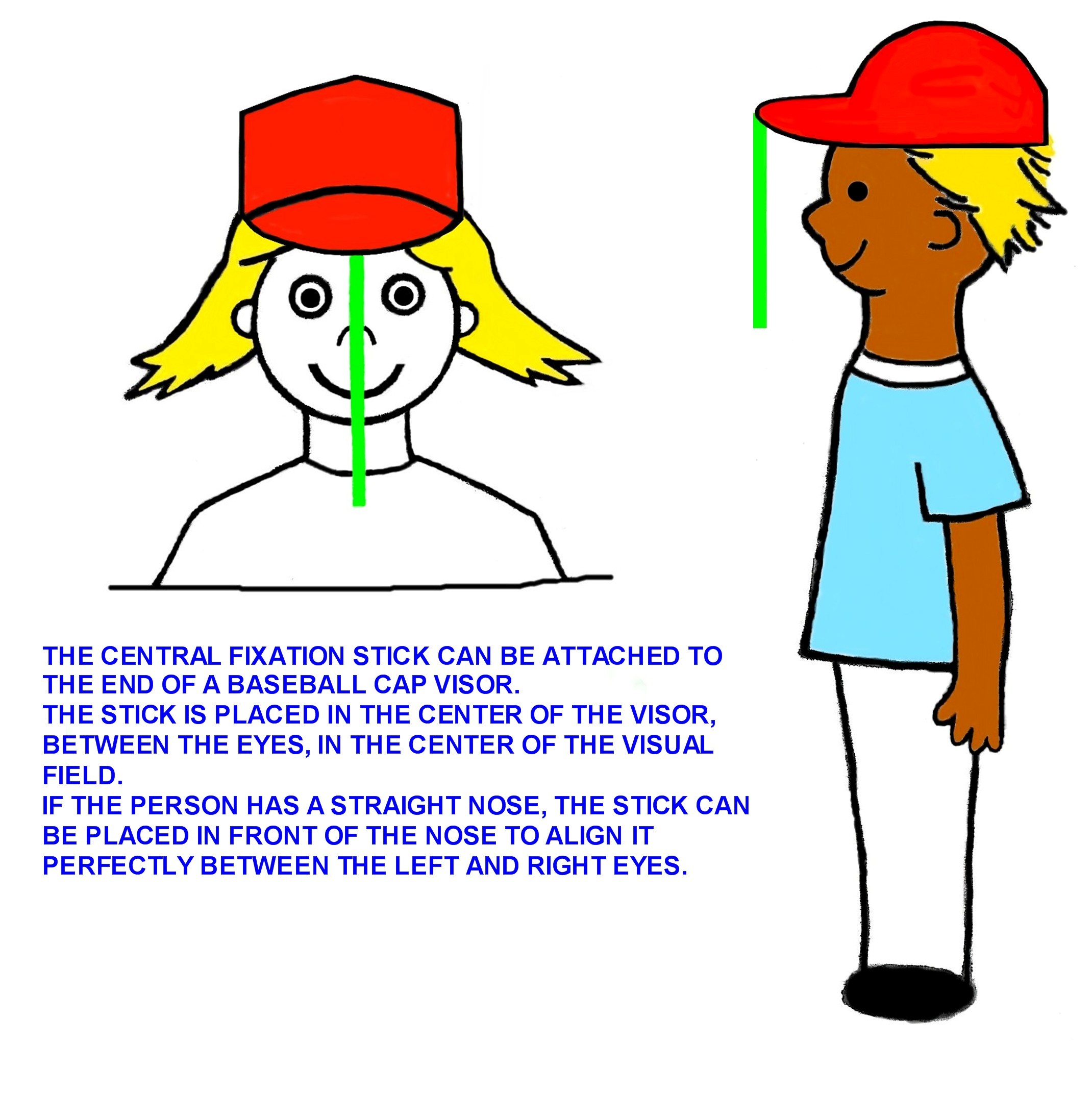
again. +Switching, shifting, central fixation as described above on; +The long swing, rock, cross crawl and other relaxation, movement, left and right brain hemisphere activation, integration activities. The central fixation stick can be made using a baseball cap; A strip of colored cloth stuffed with cardboard to keep the cloth straight in the form of a stick
is attached vertically to the end, center of the caps visor. See diagrams on right. Avoid using the central fixation stick as a eye exercise. Use it with correct vision habits # 1 to 8 to test the vision,
get the brain, visual system, eyes, body working together, correct and to learn/activate correct vision habits. This
will improve the clarity of vision. 99% of the time the stick is not used. The student uses
correct vision habits without the stick.
This tool is also called
The Vision Halo.
Taught to me by Natural Vision Teacher Thomas Quackenbush in his
school in San Francisco many years ago.
|

Questions or Comments? Contact
us at; Clearsight Publishing Co. Click
here for Google Map, Office... Google Business Website; https://clearsightpublishingco.business.site
For Natural Eyesight Improvement help, contact us by Phone;
1-781-629-3903
Revere Beach, Worcester, So. Boston, Massachusetts, South San Francisco and San Francisco, CA
Revere Beach, Worcester, So. Boston, Massachusetts, South San Francisco and San Francisco, CA
CLEARSIGHT PUBLISHING CO. - DO IT YOURSELF - NATURAL EYESIGHT
IMPROVEMENT https://www.cleareyesight-batesmethod.info
https://www.cleareyesight.info & https://www.cleareyesight-batesmethod.info are Duplicate Websites. Created to Preserve the Bates Method, Dr. Bates' Better Eyesight Magazine, Natural Eyesight Improvement on the Internet. Paid up before I retire for 50+ Years! (People in my will inherit the website, business.) This precaution was done after we were attacked by hackers 'competing authors, teachers' trying to shut down/stop publishing of this website, Ophthalmologist Bates' Better Eyesight Magazine website, free GoogleBooks, his and other Natural Eyesight Improvement-Bates Method teachers, authors' books, websites, discussion groups and publishing companies. Competitors try to sell Dr. Bates' Method for a high price. SiteLock and other defense protects this website. Notice; I no longer do E-mail, Skype, Forums due to competing authors, teachers hacking my computer, abuse, taping the training and reselling it... Our services are strictly for people who truly want to improve their eyesight naturally and to learn the TRUE Bates Method. When I have time; I certify people to teach the Bates Method, but it must be with a in person test to be sure you know the method well, have improved your eyesight. People are trained by our books, website, videos, phone help. To learn the Bates Method; Start by studying the
Copyright, Directions, Disclaimer page. It also teaches how to detect/avoid unnatural-harmful methods, teachers. Read Dr. Bates' books and Better Eyesight Magazine 3 times. Imagine you are doing the practices he describes. And do them. My books (Clark Night) contain pictures and more descriptions, examples of Dr. Bates' Method. Also see the 4 books pages on this website for many Natural Eyesight/Vision teachers, books I endorse and the History page; https://cleareyesight-batesmethod.info/id4.html